Homer Simpson: I’m not a bad guy. I work hard and I love my kids, So why should I spend half my Sunday hearing about how I’m going to hell?
God: Hmm, you’ve got a point there. You know, sometimes even I’d rather be watching football. Does St. Louis still have a team?
Homer Simpson: No, they moved to Phoenix. Congratulations to the Arizona Cardinals for outperforming the Pittsburgh Steelers in Super Bowl XLIII -- for all but about two plays. At first I wasn't picking sides, but they kind of won me over by making gutsy plays in the second half, despite getting screwed repeatedly (almost comically) by the referees.
Whatever your bias, you have to admit that the zebras took over that game, holding the Tampa crowd and the national audience in suspense several times tonight. I was convinced that one of the men in black and white would win the MVP, at least until Santonio Holmes distinguished himself at the very end.
Time will tell if the Cards can build off their surprise success next season, or if their NFC championship was an anomaly. The Falcons and Panthers, for example, got there in the past and haven't really come close since. In the NFL, it's difficult to forge a new dynasty.
I don't dislike the Steelers. It's hard to root against Mike Tomlin. He's no elder statesman, like his mentor Tony Dungy -- he's reached the peak of his profession at age 36. A win like this could have some positive sociological consequences: if there's any chance he'll make life a little easier for African-American coaches at the college level, so much the better. If Hollywood ever makes a biopic, Omar Epps is ready to play the lead.
 Finally: the Super Bowl commercials. I liked the premise of the Cars.com ad. A few others were cute, but forgettable. The rest of them were a waste of time and money. Are the advertising agencies even trying anymore? Did they lay off all the creative people? Where have you gone, Don Draper?
This may not be the best season to suggest a college football playoff, seeing as how most teams don't seem to want to play for a national championship. But I still find it ridiculous that Hawaii, which finished off an undefeated regular season this weekend, had to hope the numbers work out for them to even qualify for a major postseason bowl game.
There's no reason for this. Humans and computers who rank Hawaii so low are idiots, plain and simple. This team has not lost a game. When you rank a school with 1 or 2 (or 3!) losses ahead of Hawaii, you're no longer ranking teams. You're ranking strengths of schedule, which has nothing to do with the players on the field and everything to do with athletic departments and university presidents. What kind of assessment is that? Please find a new job or recalibrate yourself.
This kind of faulty reasoning -- Hawaii hasn't lost a game, and you might let them play in January?! -- is why BCS-level college football so desperately needs a playoff system. The problem is, no playoff suggestion has ever galvanized the NCAA and other authorities to make a change. Frankly, that's because none of these systems are as good as mine.
I hereby introduce the "8-PLUS" College Football Playoff, by which at least 8 teams figure into a postseason bracket. Sounds complicated, but it's mind-bogglingly simple. Here's how it works.
1. There are 6 major (BCS) conferences: the ACC, Big East, SEC, Big Ten, Pac-10, and Big 12. So, in my system, each of the six conference champions receives an automatic berth to the playoffs.
2. Now the BCS rankings (as they exist now, though they could always use some tweaking) come into play. Give two at-large bids to the highest ranked teams that have not already received an automatic berth. This is how independent Notre Dame would likely make the field, were they having an exceptional year.
3. So, why 8-plus? Now we look further down the rankings to add any undefeated teams that have not already been invited. Obviously, an undefeated team from a BCS conference would already have an automatic berth (or, in cases too rare to explain, an at-large berth). So these slots would be taken up by teams from other conferences -- like Hawaii from the WAC this year.
4. As for seeding the 8-plus teams, let the BCS rankings serve as your guide again. All that computation should count for something.
Let's use this year as an example. Here are Sunday's final BCS rankings:1. Ohio State (11-1)
2. LSU (11-2)
3. Virginia Tech (11-2)
4. Oklahoma (11-2)
5. Georgia (10-2)
6. Missouri (11-2)
7. USC (10-2)
8. Kansas (11-1)
9. West Virginia (10-2)
10. Hawaii (12-0)As it stands now, Ohio State and LSU are assigned to play what they're calling a national championship game, and the other bowls' authorities get to pick and choose their participants based on who's left. This year the Rose Bowl opted for #13 Illinois and the Orange Bowl chose #8 Kansas, leaving #6 Missouri, for whatever reason, out of a BCS bowl. Whatever.
Under my playoff plan, 9 teams would theoretically vie for the 2007-2008 national championship, in this seeding order:(1) Ohio State, Big Ten champ
(2) LSU, SEC champ
(3) Virginia Tech, ACC champ
(4) Oklahoma, Big 12 champ
(5) Georgia, 1st at-large team
(6) Missouri, 2nd at-large team
(7) USC, Pac-10 champ
(8) West Virginia, Big East champ
(9) Hawaii, undefeatedNow place them in a standard bracket, in which the Hawaii/West Virginia winner plays Ohio State, USC faces LSU, Missouri battles Virginia Tech, and Georgia takes on Oklahoma.
So who complains? I admit that 11-1 Kansas has a fair argument, but that one loss prevented them from playing for their conference championship. It seems somewhat unfair that a 2-loss Georgia team that also didn't play in its conference championship could make the cut instead, but really, this is a voting issue. And an anomalous situation, in my opinion. (With a playoff system in place, I should hope voters would start being more careful about which at-large teams most deserve the highest ranking.)
Now that I've explained my plan, let me point out the main flaw: location, location, location. At least 7 games must take place, which raises a simple question. Where do they take place? I think that the number of BCS bowls should expand from 5 to 7, and that the NCAA creates a system by which these 7 bowl locations take turns hosting a quarterfinal, semifinal, or final.
Any additional play-in games (#8 vs. undefeated #9, #7 vs. undefeated #10, and so on) should still receive a BCS bowl-level purse, but for convenience be hosted by the higher seed. While I can see how Hawaii might complain about having to play against West Virginia in Morgantown (to use a hypothetical example using this season's numbers), they still get to play toward a national championship, which is better than just getting to play Georgia in the Sugar Bowl.
Another concern is time; how would a playoff stretch an already lengthy college football season? It wouldn't. The bowl season is already at least 4 weeks long. Play-in games and quarterfinals can take place at the same time as those December bowls, with the semifinals and final game scheduled for January. The season gets no longer because the existing timetable is perfect.
I fully realize that I'm a nobody, but it doesn't take a background in university athletics to just possess some damn common sense. This plan works, and better yet, favors the monolithic BCS conferences in every turn. Were these conference's commissioners presented with such a plan -- and frankly, I don't care who tells them -- they'd have to see that a good playoff system doesn't have to take them out of their comfort zone. Get their recommendations, and who knows what could happen?
I don't even want the credit for this or any similar playoff system. I just want college football to start mattering.
 The NFL draft is this weekend, and with it comes all that talk about freakish physical specimens with tremendous upside (and that's just Mel Kiper's hair!). I was reminded that I never got around to reviewing The Blind Side: Evolution of a Game, by Michael Lewis. It's probably one of the best sports books I've ever read.
Like his previous book Moneyball, Lewis does something rare: he gets me to care simultaneously about the game and the business behind the game. Here he profiles Michael Oher, a jaw-dropping wall of a young black man with surprising speed for someone his size. But he has slipped through the scholastic system as well as other societal cracks, and catches up with the help of several white people in the Memphis community, not all of whom act selflessly.
Lewis also tells the story of the left tackle, a long-undervalued position in the offensive line. (Because most quarterbacks are right-handed, the left tackle usually protects the QB's blind side so he won't be sacked by the defense.) He opens the book with an ending -- specifically, the painful end of QB Joe Theismann's career under the weight of defensive specialist Lawrence Taylor. Theismann's starting left tackle was on the sidelines that night.
Guarding against a revolutionary player like Taylor was one of the reasons the left tackle became a marquee position; the other was the immediate success of Bill Walsh's West Coast offense. Lewis explains how the NFL began to target the rare athlete that combined size, strength, agility, and speed for the left tackle position, and paid those players handsomely. (Generally, the left tackle is the second-highest paid player on a team, after the QB.)
This history lesson parallels the increased regard for Oher, as his uniqueness becomes readily apparent to scouts and coaches in the well-oiled machine of college football in the South. His recruitment by SEC teams feels peppered with some lapses in integrity, if not outright corruption. He eventually chooses a team -- this one -- though I find it curious that his listing on ESPN's roster (#74) is still without a link to his stats.
(Author's Note: I'm using Super Bowl Sunday as an excuse to move my weekly post of college basketball seedings to Thursday nights, where they'll stay until the end of the regular season.)
So this is it. The Super Bowl. Apparently it involves a football game, but there's so much more to the story.
 According to HowStuffWorks, the average American will double his or her consumption of snack foods today. Citing the Snack Food Association, they say that during the game America should consume about 30.4 million pounds of snack foods, 11 million pounds of potato chips, 13.2 million pounds of avocados, 8.2 million pounds of tortilla chips, 4.3 million pounds of pretzels, 3.8 million pounds of popcorn, and 2.5 million pounds of snack nuts. Plus untold amounts of dip and salsa, and one leftover fruitcake from the holidays.
Wow. I don't want to criticize the nation for such gluttony, but I do recommend buying antacid tonight, before it flies off the shelves. (Experts estimate a sales increase of 20 percent the day after.)
Here in Las Vegas, there's a lot more to bet on than just the spread (Colts by 7) and the over/under (48 points). Will Peyton Manning's first pass be complete or incomplete? Which team scores first? Who leads by halftime? Will there be a scoreless quarter?
And those are just the bets that make sense. Earlier this week I went to the South Point casino and checked out their Race and Sports Book. An entire column of their giant LCD betting board was devoted to various bets regarding Colts rookie running back Joseph Addai. There were hundreds of betting opportunities.
Other Super Bowl talking points:
1. "Super Bowl Shuffle" (as performed by the 1985 Chicago Bears) was nominated for a Grammy. The team lost to Prince, who performs the halftime show today. Is this the cheesiest nomination the Grammys have ever given? And if Mike Ditka ever put out an album, would it sweep the major categories?
2. Advertisers are paying up to $2.6 million for a 30-second ad. In the Internet age of viral video, where low-budget creations can be watched by millions, is the investment still worth it? Wouldn't the money be better spent renting a Yankees player for an hour?
3. Before this year, no African-American head coach had ever made it to the Super Bowl, and now we have two: Lovie Smith and Tony Dungy. Is their success an aberration, or a sign of things to come? The NFL hasn't made as many strides in its front-office diversity as, say, the NBA.
Feel free to use these points in a discussion, especially if you know nothing about football. Or you could stuff your face with snacks.
The phrase is explained here.
The AFC and NFC championships are decided this weekend. For those readers who truly don't know football from Adam, the winners of these games face off in the Super Bowl.
In the NFC game, the Chicago Bears host the New Orleans Saints. The former is a traditional power with a long history of hard-fought success. The latter is a great sports story getting overshadowed by sociopolitical significance. That anyone believes a Saints victory would represent a triumph over Hurricane Katrina frustrates me. I don't want to deny the local fans a bit of escapism, but bandwagon riders need to question their motivations.
Frankly, I'm more interested in the AFC matchup between the New England Patriots and the Indianapolis Colts. Normally, I don't care for either, but I'm perversely curious because clutch kicker Adam Vinatieri, who won some Super Bowls for the Patriots, defected to the Colts. More to the point, which end result would be funnier?
1. Adam wins the game for his new team on a last-second field goal.
2. Adam wins the game for his old team by missing said field goal.
Clearly, a close AFC game is in the best interests of America.
55 Fiction Friday may have suffered hibernation sickness.Inspired by the movie, the fourth graders escaped their tour group and snuck into the employee lounge to wait. There they found Dr. Palfrey immersed in an ornithology guide, Dr. Mendoza solving a crossword, and Dr. Ziegler taking a nap.
They had hoped that, once the museum closed, these boring scientists would come to life.
Can you consider an Oscar nominated actor underrated? Maybe, in the case of Greg Kinnear. "Meteoric" doesn't begin to describe his early career path. Filmography highlights: hosted "Talk Soup" on E! until 1995. Filled William Holden's shoes in the remake of Sabrina in 1995. Hosted "Later" on NBC until 1996. Got the Academy's attention for 1997's As Good As It Gets.
And then? The aspiring actor's more realistic dream: a steady career. He's had a healthy mix of high-profile supporting work (Nurse Betty, We Were Soldiers) and low-budget starring roles (Auto Focus, The Matador). Last week I saw advanced screenings of each: Invincible and Little Miss Sunshine.
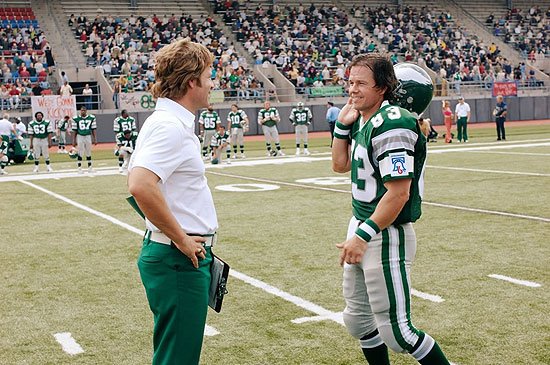
 Invincible is the latest in a genre that Disney has mastered these past few years: the inspirational true sports story. Like Glory Road, Miracle, Remember the Titans, or The Rookie, we relive a purer era of sport that retains all of the action and none of the sex and profanity. And it totally works every time.
Mark Wahlberg takes time out of his busy pants-dropping schedule to play Vince Papale, a regular guy who happens to be built for pro football, despite little organized experience in the sport. He becomes a beacon of hope among his working-class union friends, straight out of a Philadelphia production of On the Waterfront. He gets his chance to become a contender when new Eagles coach Dick Vermeil (Kinnear) holds open tryouts.
It's hard to make audience members care about a special teams player whose primary job is to run down the kickoff returner, but the movie makes it work. Kinnear and Wahlberg do not share a lot of screen time, but still manage to drive home the theme of making the most of an opportunity when given a clean slate.
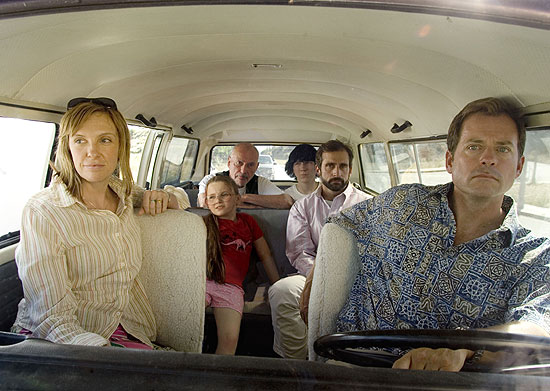
 Little Miss Sunshine is, well, a very different film. The title creates the expectation that creepy child beauty pageants (revived in our memory by recent events) will be mocked mercilessly, and they are, but only in the film's last half hour. It's everything that comes before the climactic competition that makes this movie so special.
This is a quirky family comedy that manages to avoid all the pretentious traps of other quirky family comedies. (I'm looking at you, Wes Anderson.) The film works because each family member provides the others with just the right amount of therapy, despite their individual insecurities.
I imagine most of the praise will go to Steve Carell's tragicomic portrayal of a suicidal academic, but I was more impressed with Kinnear's tougher role as the unlikable motivational speaker and family leader. No complaints, though, from what should be the year's best acting ensemble.
All in all, Greg Kinnear has had quite a run. You accept him on screen, completely forgetting that he wasn't always known as an actor. Consider, by way of comparison, another snarky ex-host with a similar name, who also worked his way up the TV ranks before graduating into movies: Craig Kilborn. That's the more common story: typecasted, into the same comedic jerk persona.
55 Fiction Friday feels typecast as a storyteller.
The checkpoint guards believed that Samuel merited special attention. After all, this was not a case of racial profiling. This was science.
Their stacks of news alerts had emphasized shoe bombs and liquid explosives, so the decision was swift and fierce. Dr. Scholl be damned; in this airport, Samuel would most certainly not be gellin'.
Looking back over the past few months, I've noticed that for a lawyer who blogs, I don't write about the law. (Well, I did mention a joint tenancy in my review of The Break-Up.)
That will have to change. I'll use baby steps to get there, just as the best physical therapist in Pittsburgh might suggest to the recently injured Ben Roethlisberger. That's not my best segue, but I did want to talk about motorcycles and professional athletes.
Do they mix? As a matter of attitude, oh yes. Motorcycles have thrived for decades as an expression of virility. As a matter of public relations, oh no. Pro franchises do not want to take the hit of losing one of their athletes to a motorcycle injury, and face the question of whether to cut their losses or voluntarily keep the player on the roster as he heals.
But as a matter of contract law? The answer is less clear. Specific agreements between teams and players may directly address motorcycles (Roethlisberger's contract apparently did not), but according to the Sports Law Blog, the standard NFL contract says:3. OTHER ACTIVITIES. Without prior written consent of the Club, Player will not play football or engage in activities related to football otherwise than for Club or engage in any activity other than football which may involve a significant risk of personal injury. Player represents that he has special, exceptional and unique knowledge, skill, ability, and experience as a football player, the loss of which cannot be estimated with any certainty and cannot be fairly or adequately compensated by damages. Player therefore agrees that Club will have the right, in addition to any other right which Club may possess, to enjoin Player by appropriate proceedings from playing football or engaging in football-related activities other than for Club or from engaging in any activity other than football which may involve a significant risk of personal injury.This clause, taken alone, seems to address activities during the season and offseason. Which makes sense: an NFL team doesn't want its player to moonlight by playing in some rival upstart summer league. Or participate in extreme weight-lifting competitions. Or wrestle alligators.
But would riding a motorcycle qualify as "any activity other than football which may involve a significant risk of personal injury"? Possibly. There are precedents where athletes on motorcycles hit a curb, pole, or wet spot and injured their arms or legs.
Ben Roethlisberger, the Steelers quarterback who won the Super Bowl last season, suffered injury not because his motorcycle took a spill, but because a woman in a Chrysler hit him. He was thrown off the motorcycle, and his head came into direct contact with the pavement because he wasn't wearing a helmet.
Ah, no helmet. Now the picture is clearer: riding a motorcycle without a helmet involves a significant risk of personal injury. The Steelers coach and organization warned him, but Roethlisberger assured them he'd be careful. But anyone who's taken a defensive driving class knows that one driver being completely careful is only a small part of the story. You still have to worry about every other idiot on the road.
Perhaps his Steelers teammate Joey Porter said it best:
"Some guys are real good on motorcycles and know what they're doing, but accidents happen," Porter said. "I can't knock the guy for doing it, but it's probably not the wisest thing to do. I don't own a bike because I don't trust them."
Porter occasionally gets on a Jet Ski, but he said that's different from steering a motorcycle through heavy traffic. Roethlisberger acknowledged many drivers become distracted when they see him riding, shouting or waving at him.
"If I fall off a Jet Ski, I hit the water, and I like my odds," Porter said. "I'm going to get wet. What I say about motorcycles is that concrete is undefeated."
 Congratulations to the Arizona Cardinals for outperforming the Pittsburgh Steelers in Super Bowl XLIII -- for all but about two plays. At first I wasn't picking sides, but they kind of won me over by making gutsy plays in the second half, despite getting screwed repeatedly (almost comically) by the referees.
 Finally: the Super Bowl commercials. I liked the premise of the Cars.com ad. A few others were cute, but forgettable. The rest of them were a waste of time and money. Are the advertising agencies even trying anymore? Did they lay off all the creative people? Where have you gone, Don Draper?